Noise Impact Assessments for Planning & Development

Noise Impact Assessments for Planning Development

Navigating the complexities of the National Planning Policy Framework (NPPF) and local council requirements is a critical step for any successful development. At ETS Acoustics, we provide comprehensive Noise Impact Assessments and thorough Environmental Noise Surveys tailored to support planning applications for residential, commercial and mixed-use projects across Essex and the surrounding regions.

Whether you are working on a new-build scheme in Chelmsford, a commercial-to-residential conversion in Halstead, or a bespoke project in Colchester, I provide the dedicated expertise to ensure your project meets the highest technical standards. I specialise in delivering Planning Noise Reports that satisfy even the most stringent local authority conditions, providing a personal, end-to-end service to help you move from the design phase to construction without delay.

Technical Excellence and Compliance

Our assessments are conducted in strict accordance with the latest industry guidance and British Standards, including:

  • BS 8233:2014: To ensure appropriate internal ambient noise levels for habitable rooms.
  • ProPG: Planning & Noise: Providing a risk-based approach for new residential developments exposed to transport noise.
  • WHO Guidelines: Incorporating World Health Organization standards for external amenity areas and sleep disturbance.

From initial baseline noise monitoring to providing detailed mitigation strategies—such as high-performance glazing and acoustic ventilation specifications—we provide the data-driven insights needed to secure your planning approval.


  • Call me

Process: From Site Survey to Planning Approval

Securing planning permission often hinges on meeting strict environmental noise standards. At ETS Acoustics I manage the entire acoustic assessment process personally, ensuring technical accuracy at every stage to give the noise element of your application the best chance of success.”

  1. Initial Consultation & Desktop Study
    I begin by reviewing your site plans and local council requirements. This allows me to identify potential noise sources—such as nearby road traffic (A12/A120), rail lines, or industrial units—and determine the specific scope of the assessment required.
  2. On-Site Baseline Noise Monitoring
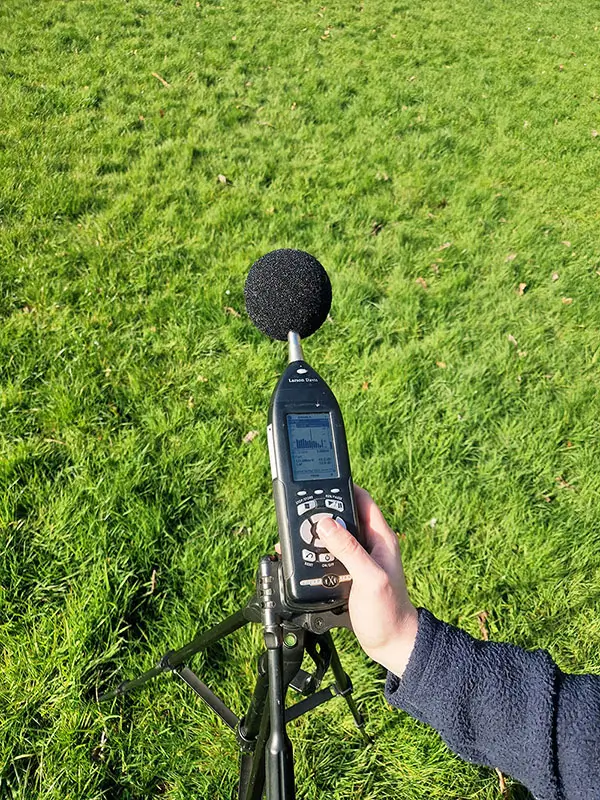
    I attend your site to install professional, Type 1 acoustic monitoring equipment. Typically, I conduct a 24-hour noise surveyto capture the “baseline” sound levels during both day and night periods. This ensures the data is representative of the actual acoustic environment.
  3. Data Analysis & Acoustic Modelling
    Back in the office, I process the logged data to determine the specific noise levels (LAeq, L90, and Lmax). Using this data, I perform calculations in line with BS 8233and ProPGto predict how external noise will affect the future residents or users of your building.
  4. Mitigation & Design Recommendations
    If the noise levels exceed recommended limits, I don’t just report the problem—I provide the solution. I specify practical mitigation measures, such as:

    • Acoustic Glazing: Detailed specifications for windows and doors.
    • Alternative Ventilation: Specifications for trickle vents or mechanical systems to ensure fresh air without noise ingress.
    • Site Layout Advice: Suggestions for building orientation or acoustic barriers/fencing.
  5. Delivery of the Planning Noise Impact Assessments
    Finally, I produce a comprehensive, professional report ready for submission to your local planning authority. My reports are designed to be clear, concise, and technically sound, specifically aimed at discharging noise-related planning conditions.

For complex sites or large-scale industrial developments, standard calculations may not provide the full picture. I offer advanced 3D noise modelling to accurately predict sound propagation across your site.

Using digital terrain data and “what-if” scenarios, I can visualize noise impact through detailed Noise Contour Maps. This helps optimize your site layout and can often save significant costs by targeting mitigation (like glazing or barriers) only where it is truly needed.

Explore 3D Modelling Services

  • Call me